
Lawn Maintenance
Biweekly Lawn Mowing in Frederick, MD
Every-other-week mowing with edging and trimming for Frederick properties — the right choice when shade coverage, property size, or summer growth rate makes a two-week interval practical without violating the one-third rule.
A biweekly mowing interval on a Frederick fescue lawn is appropriate when growth rate allows the turf to reach 5 to 5.5 inches maximum between visits — the threshold where removing the overgrowth back to 3.5 inches stays within the one-third rule. In practice, this means biweekly works well during Frederick's July-August heat slowdown and on shaded properties with naturally reduced growth rates. During May, September, and October growth peaks, biweekly intervals often allow overgrowth that exceeds what a single cut should remove.
Managing a biweekly Frederick lawn during active growth periods requires running the mowing height at 3.5 to 4 inches rather than the standard 3 to 3.5 — the slightly higher maintenance height means the overgrown grass coming in at the two-week mark still stays within a manageable removal range. The cut may not look as uniformly tight as a weekly-mowed lawn, but it avoids the stress of removing too much blade at once on an overgrown property.
Biweekly mowing on a Frederick lawn generates significantly more clipping volume per visit than weekly service — because the grass has grown more between cuts. We manage this by distributing clippings as mulch when volume is moderate and collecting when volume is high enough to create surface mats that block light and air from the turf below. Heavy biweekly clipping mats left on the surface contribute to bare patches if not managed.
Biweekly Mowing in Frederick
When a Two-Week Interval Makes Sense
Biweekly mowing is the right fit for Frederick properties where the actual growth rate supports a two-week interval without excessive overgrowth. The most natural biweekly windows are July and August — when tall fescue growth slows significantly in heat — and for shaded Frederick properties under mature tree canopy where growth rates are lower year-round. Properties with smaller turf areas may also find that weekly service generates unnecessary visits during slow growth periods. We help Frederick property owners choose the interval that produces the best result for their specific property's growth patterns rather than defaulting to weekly or biweekly as a fixed preference.
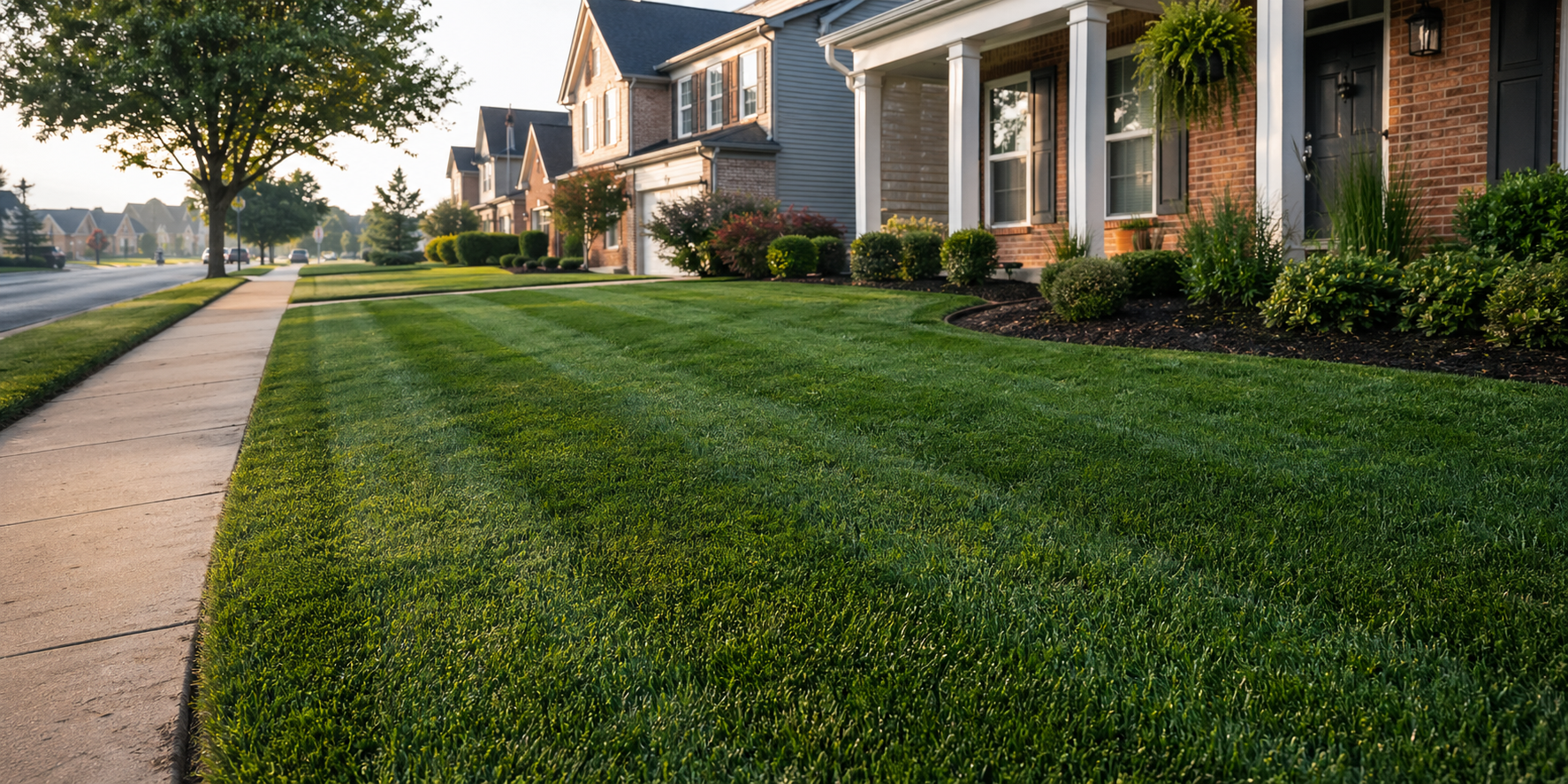
Managing the Cut on Biweekly Frederick Lawns
The main technical challenge of biweekly mowing in Frederick is the overgrowth that accumulates during peak growth periods. When a Frederick fescue lawn reaches 6 to 7 inches between biweekly visits in May or September, returning it to 3.5 inches requires removing more than the recommended one-third of the blade. We manage this by raising the deck for the first pass when overgrowth is significant — cutting to 5 inches on the first pass, then to 3.5 inches on a second pass or at the following visit. This is more work per visit but avoids the shock of a single aggressive cut on turf that has been allowed to overgrow.
Transitioning Intervals
A practical approach for Frederick properties is weekly mowing through spring and fall growth peaks, shifting to biweekly in July and August when growth slows. This matches service frequency to actual growth rate rather than committing to either schedule year-round regardless of what the grass needs.
Clipping Collection on Biweekly
We collect or redistribute heavy clipping loads after biweekly mowing visits rather than leaving them to mat on the surface. The additional volume from two weeks of growth between cuts can exceed what the turf surface can absorb without creating coverage problems.
Biweekly Service Setup
Estimate
Assess the property and recommend whether biweekly is appropriate year-round or only in certain seasons.
Schedule
Assign to a consistent biweekly rotation — same day every two weeks through the season.
Seasonal Adjustment
Shift to weekly visits during spring and fall peak growth periods if overgrowth requires it.
Season Close
Final visit timed before first hard frost, mowing slightly lower to reduce winter mat conditions.
Best Months for Biweekly
July and August in Frederick, when fescue growth slows in heat and humidity, are the natural biweekly window. Late October and November also support two-week intervals as seasonal growth declines.
Shaded Properties
Frederick properties with heavy tree canopy — under oaks, maples, and tulip poplars — grow more slowly than full-sun lawns and frequently support biweekly service year-round without significant overgrowth.
Edge Maintenance Biweekly
Edges along driveways and sidewalks grow more slowly than the main turf — biweekly edging keeps lines defined without the same growth pressure that drives weekly mowing.
Rental Properties
Frederick rental properties often work well on biweekly schedules — simple coordination, predictable tenant impact, and appropriate frequency for most residential lot sizes.
Set Up Biweekly Mowing for Your Frederick Property
Contact us to discuss whether biweekly or weekly service is the right fit for your Frederick lawn's growth rate.
Request An EstimateIs biweekly mowing bad for Frederick fescue?
Not if growth rate supports it. Biweekly mowing is appropriate when the grass grows slowly enough that a two-week interval keeps the height within a manageable range. During peak spring and fall growth in Frederick, biweekly often allows too much overgrowth that violates the one-third rule when corrected in a single cut.
Can I switch between weekly and biweekly based on season?
Yes. Many Frederick properties benefit from weekly service in May, June, September, and October — peak growth periods — with biweekly visits in July and August when growth slows. We can adjust frequency seasonally rather than committing to one interval year-round.
What do you do with extra clippings from biweekly mowing?
We distribute clippings across the surface when volume is moderate — they decompose and return nutrients to the soil. When biweekly clipping volume is heavy enough to form surface mats, we collect and remove them rather than leaving coverage that can suffocate the turf below.
Weekly Lawn Mowing
Weekly mowing for Frederick properties during peak growing season — better for May, September, and October growth rates.
Rental Property Lawn Care
Biweekly mowing coordination for Frederick rental properties — managed through property managers.
Shade Lawn Solutions
Shaded Frederick properties with naturally slow growth rates are often well-suited to biweekly service year-round.